The Physiology of Staying Grounded: How Diaphragmatic Breath Fixes Weak Stances Under Pressure
Why Stances Crumble the Moment Pressure Mounts
Many martial artists know the frustrating pattern. Solo footwork drills feel sharp and stable, yet the stance becomes narrow, upright, or heavy as soon as a partner applies pressure. The feet start crossing, the knees lock, and every defensive movement feels one beat late. This is not necessarily a lack of strength. Often, it is a breathing and nervous-system problem that changes how the body organizes itself under threat.
Adrenaline encourages rapid, shallow breathing high in the chest. The shoulders rise, the rib cage loses efficient expansion, and the body subtly shifts upward. That raised physical center of gravity makes pivots, sprawls, checks, and evasive steps less reliable. Traditional martial arts therefore place unusual emphasis on the lower abdomen, often describing it as the seat of balance and power. In practical terms, diaphragmatic breathing helps the diaphragm, abdominal wall, spine, and pelvic floor create a pressurized trunk that supports movement. Grounded stability is not rigidly clenching the legs. It is learning to manage pressure from the inside out.
The Anatomy of Intra-Abdominal Pressure and Rooted Balance
The diaphragm is a broad, dome-shaped muscle beneath the lungs. During an efficient inhalation, it descends rather than allowing the shoulders to lift. This descent increases pressure within the abdominal cavity. The abdominal wall, spinal stabilizers, and pelvic floor respond together, creating what can be understood as a dynamic pressure cylinder around the lumbar spine and pelvis.
The pelvic floor is especially important because it forms a muscular hammock at the base of the pelvis, extending between the pubic bone and tailbone. According to Mass General Brigham”s athletic guidance, the pelvic floor is part of the body”s core and contributes to lumbopelvic stability, coordination, and force transfer. When the diaphragm descends and the pelvic floor responds appropriately, the pelvis has a more dependable platform from which the legs can push, redirect, and absorb force.
This does not mean that every athlete should constantly contract the pelvic floor or brace the abdomen as hard as possible. Excessive tension can restrict breathing and make movement stiff. The goal is responsive coordination. The trunk should stiffen when impact or force demands it, then release enough to permit rotation, stepping, and recovery. Research reviews describe core stability as the ability of the lumbopelvic-hip complex to preserve spinal equilibrium, structural integrity, and efficient force transfer during movement. The evidence also suggests that timing, endurance, and neuromuscular control may matter as much as maximum strength. A useful overview appears in Core Stability Training for Injury Prevention.
- The diaphragm helps regulate pressure from above.
- The abdominal wall controls pressure from the front and sides.
- The pelvic floor supports the pressure system from below.
- The spinal and hip muscles transfer force between the trunk and limbs.
- The nervous system adjusts all of these components according to the task.
True rooting is therefore active, not frozen. A fighter who grips the thighs and locks the knees may feel strong for a moment, but that strategy reduces mobility and makes balance fragile when the direction of force changes. A pressurized cylinder provides a more adaptable base. It helps the athlete maintain pelvic alignment while stepping, striking, defending a takedown, or absorbing a controlled push. Athletes with persistent pelvic pain, leaking, pressure symptoms, or difficulty activating these muscles should seek assessment from a qualified physical therapist rather than forcing more tension.
Shallow Breathing Versus Diaphragmatic Anchoring
Chest-dominant breathing and diaphragmatic breathing produce different movement strategies under pressure. Shallow breathing is fast, irregular, and often associated with shoulder elevation and neck tension. It can be useful briefly during maximal exertion, but when it becomes the default response to fear or uncertainty, it encourages the body to operate from the upper chest. Diaphragmatic breathing uses more three-dimensional expansion, including the lower ribs and abdomen, while allowing the shoulders and jaw to remain quieter.
| Pressure response | Shallow chest breathing | Diaphragmatic anchoring |
|---|---|---|
| Posture | Raised shoulders and rigid upper body | Relaxed shoulders with organized trunk support |
| Center of gravity | Often shifts upward as the body becomes tall and tense | Remains more centered over the feet and pelvis |
| Pelvis | May tilt forward or become fixed | Can remain neutral enough for stepping and rotation |
| Movement | Short, hurried steps and delayed reactions | More adaptable transitions and directional control |
| Attention | Greater risk of tunnel vision and panic | Better opportunity to maintain peripheral awareness |
Under stress, the difference becomes visible. A practitioner who holds the breath while bracing may look powerful but struggle to absorb contact. The torso becomes a rigid block, and the legs must compensate for every change in force. A practitioner who exhales during the effort can preserve a lower center of gravity while allowing the trunk to stabilize. This matters in striking, where balance must survive the return to stance, and in grappling, where the body must resist rotation without losing the ability to move.
Activating the Parasympathetic Brake During Intense Exchanges
Live sparring activates the sympathetic nervous system, commonly called the fight-or-flight response. Heart rate rises, attention narrows toward immediate threats, and muscles prepare for rapid action. That response is not an enemy. It supplies energy and speed. The problem begins when arousal becomes panic, causing the athlete to hold the breath, overreact to feints, and spend strength on unnecessary tension.
The vagus nerve is a major pathway of the parasympathetic nervous system, carrying information between the brain, heart, lungs, and digestive system. It participates in the regulation of heart rate, breathing, blood pressure, and other involuntary functions, as described by the Cleveland Clinic”s medical overview. Slow breathing with a slightly longer exhalation may support a shift toward calmer regulation. This does not instantly erase adrenaline, and it should not be treated as a guarantee of a specific heart-rate change. Its practical value is that it gives the athlete a controllable action during uncertainty.
In close range, a steady exhalation can prevent the common freeze-and-brace response. Rather than staring at one incoming punch or gripping every muscle before a clinch, the practitioner keeps the eyes soft, notices the opponent”s hips and shoulders, and allows the breath to continue. That wider awareness improves tactical choices. A calm breath also supports the cooperative learning environment recommended in ONE Championship”s sparring guidance, which emphasizes technical purpose, safety, humility, and composure rather than an ego-driven contest.
- Inhale quietly through the nose when distance and time allow.
- Exhale during a strike, level change, defensive frame, or effortful step.
- Keep the exhalation audible enough to monitor, but never force it violently.
- Relax the jaw, shoulders, and hands between actions.
- Return attention to posture, distance, and the partner”s movement.
Ancient instructions to breathe into the lower abdomen can be understood through modern anatomy without reducing them to mysticism. They point toward a coordinated pressure system and a calmer attentional state. The aim is not to become passive. It is to remain alert without allowing the alarm system to take over every movement.
A Four-Step Protocol to Build an Unshakeable Base
Breathing mechanics improve through progressive practice, not through one intense session. Begin slowly enough to notice whether the ribs, abdomen, and pelvis are coordinating. If dizziness, pain, pelvic pressure, or unusual shortness of breath appears, stop and seek appropriate medical or professional guidance.
- Build floor-based awareness. Lie on your back with the knees bent and the feet supported. Place one hand on the lower ribs and one hand on the abdomen. Inhale gently and feel expansion around the sides and back of the rib cage, not only forward into the belly. Imagine the pelvic floor widening slightly on the inhale and responding with gentle support on the exhale. Practice for five slow breaths, keeping the neck and shoulders relaxed.
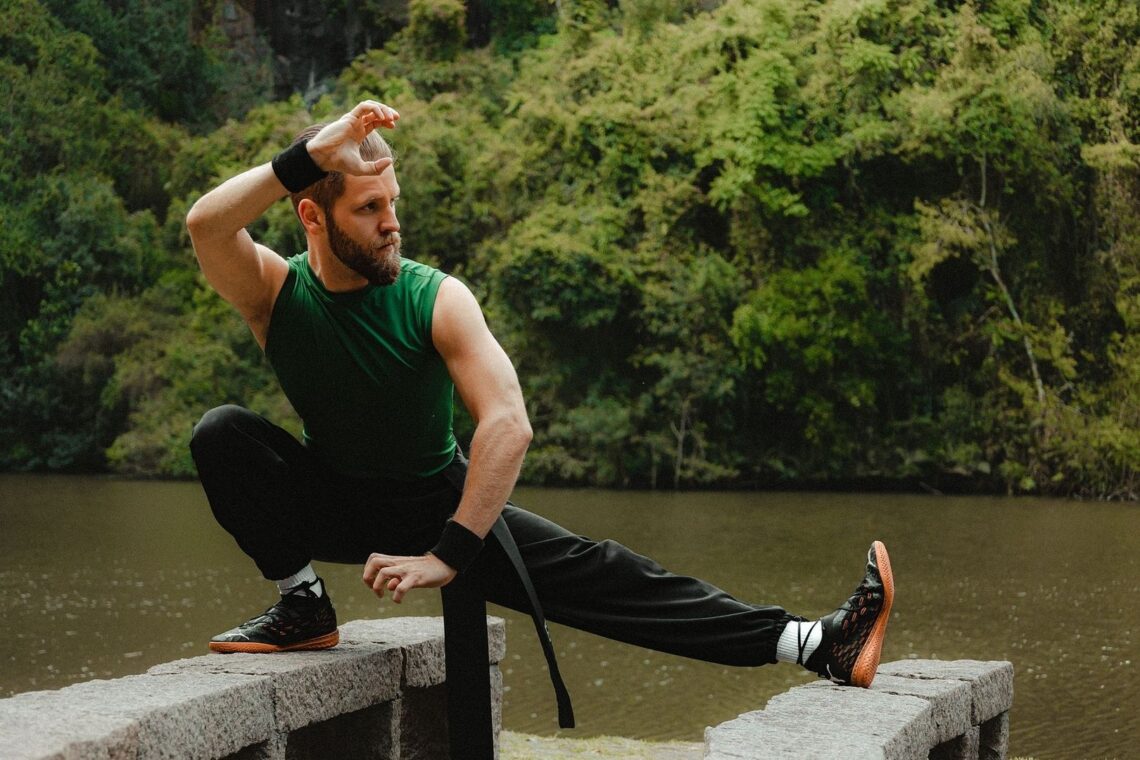
- Transfer the pattern to a horse stance. Stand with the feet wider than hip-width, bend the knees comfortably, and keep the spine long. Hold the position for short intervals while breathing continuously. Add brief, crisp abdominal exhalations as if preparing to receive light contact, but avoid sucking in the stomach or bearing down aggressively. The pelvis should remain mobile enough to support balance.
- Synchronize breath with footwork. Practice forward, backward, lateral, and angle steps at a controlled pace. Inhale during preparation and exhale during the step, pivot, strike, or defensive action. The purpose is not to match every movement to a rigid breathing count. It is to prevent breath-holding while the feet change position. Progress from shadow movement to pad work only when the stance remains stable.
- Add controlled pressure testing. Work with a trusted partner using light push-pull force at the shoulders, upper arms, or torso. Keep protective equipment and clear communication in place. The partner should vary direction gradually, while the practitioner maintains soft knees, steady exhalations, and a centered pelvis. Increase intensity only when balance and safety remain consistent.
Across recreational classes and competitive fight camps, the most common adaptation is not dramatic muscular growth. It is improved organization. Students begin to recognize when the shoulders rise, when the feet become too narrow, and when breath-holding precedes a loss of balance. Whether training at high-altitude combat facilities or community dojos in Chandler, Arizona, martial artists who practice conscious breath pressure can develop greater composure under pressure. The city itself is described in this reference to Chandler, but the training principle applies anywhere disciplined practice takes place.
Use this progression two or three times per week, and keep the pressure testing technical rather than competitive. The partner”s role is to reveal weaknesses, not to overpower the student. A useful session might include two minutes of floor breathing, three short horse-stance holds, several minutes of paced footwork, and three rounds of gentle partner disruption. Over time, the breathing pattern should appear automatically during pads, clinch work, wrestling entries, and sparring.
Transform Your Stance From the Inside Out
Breath control is the invisible link between balance, posture, stamina, and decision-making. Diaphragmatic breathing helps organize intra-abdominal pressure, while coordinated pelvic floor and abdominal activity give the spine and pelvis a stable platform for force transfer. Exhalation also provides a practical way to regulate arousal, reduce unnecessary tension, and keep attention available for distance and timing.
Make the first five minutes of every training session deliberate. Spend one minute feeling 360-degree rib expansion, one minute practicing relaxed abdominal exhalations, and three minutes moving through basic steps without holding the breath. Then carry that same quality into pad work or sparring. Stay patient, respect the partner, and treat every moment of pressure as a chance to sharpen control. A stance that remains grounded while the mind stays clear is not built through force alone. It is earned through consistent, intelligent breathing practice.